MY ROLE
Product Manager
TEAM
Product Manager
Product Owner
Project Coordinator
(7) UX Designers
(3) UX Researchers
(11) Apprentices
TIMELINE
5 months
"Alexi was a true momentum builder and a proactive leader from the start....Her ability to bring clarity to ambiguity and integrate input from across teams made a big impact."
Amir Panahi
Product Owner

Expert-Level Accuracy, Influencer-Level Content
Product Discovery
Vision Development
Product Strategy
GenAI
HealthTech
MVP
Comparative Concept Testing
Agile Methodologies
This case study explores the discovery research, concept development, and product strategy that informed Akari - an AI-powered platform designed to help health content creators combat misinformation by connecting them to peer-reviewed scientific sources through APIs and VeriSciLM, a fine-tuned AI model developed by the public-benefit incubator: Science to People. Akari is set to launch its pilot in 2026 as part of the VeriSci suite of products.
Introduction
In an age where 4 out of 5 people seek health information online, the need for accessible, accurate, and engaging content has never been greater. Yet, the digital space is flooded with misinformation - 87% of health-related posts contain inaccuracies, and over half of consumers believe false claims, fueling harmful outcomes and eroding public trust in the health system.
Science to People is addressing this crisis by developing technology that transforms complex scientific research into clear, trustworthy, and relatable communication. Their first product, VeriSciLM, is a fine-tuned language model bridging the gap between science and public understanding. Building on this foundation, they’re expanding their impact with targeted tools - like Akari, a creator-facing platform featured in this case study—that help communicators share accurate information with confidence. In an era of fragile public trust, Science to People proves that evidence-based science can cut through the noise and drive meaningful change.
The Problem Space
The digital landscape has made health information more accessible than ever, but it has also amplified challenges in accuracy, engagement, and trust.
Health and Wellness Content Creators are crucial in shaping public understanding of complex health topics, but they face significant challenges that limit their ability to produce high-quality, trustworthy content efficiently.


Industry Challenge 1:
Complex health messaging hinders public understanding
(Source: Science to People Business Case)
Challenge 2:
Difficulty interpreting health data and scientific research due to lack of formal training
(Source: Science to People Business Case)
Challenge 3:
Inefficient and time-consuming research process with multitude of tools
(Source: Science to People Business Case)
Challenge 4:
Maintaining unique branding and voice without increasing chances of misinterpretation
(Source: Science to People Business Case)
Challenge 5:
Changing content across social platforms can lead to increased workload and diluted messaging consistency
(Source: Science to People Business Case)


The Starting Point
Our team was tasked with building the 3rd variation of VeriSci for content creators - translating this simple chat interface into an AI-powered SaaS product. As stated by the CEO: "An AI-powered platform that is better educated than ChatGPT, trained to think like a public health expert, and writes like an influencer."
We inherited a business case slide deck, preliminary PRD, a launched VeriSciLM beta, and an early prototype (MVP2). Building on user insights and testing feedback, we set out to reimagine the product with a renewed strategy and clearer value proposition - empowering health and wellness content creators to produce trustworthy, science-backed content with ease.
Research and Beta Analytics
Our research combined insights from user interviews, concept testing, and beta analytics, to understand the workflows, pain points, and needs of Health & Wellness Content Creators across Facebook, YouTube/Instagram, TikTok/Twitter, and LinkedIn.
329
Total Beta Conversations
9.6
Avg. Conversation Length in Turns
5
Unique Content Categories


Insight 1:
68% of VeriSci Beta users were shaping social media content
Indicating users may need help adapting content for specific platforms.
(Source: Beta analytics)
Insight 2:
Dropping a Link is the 2nd highest input, after text
Suggesting users also need help processing existing content, not just generating it.
(Source: Beta analytics)
Insight 3:
9.6 average turns per user conversation
Suggesting iterative refinement is a core behavior and users treat AI as a co-creator, not just a generator
(Source: Beta analytics)
Insight 5: Only 10% of beta users explicitly requested fact-checking, despite this being a core user need from interviews,
suggesting a feature discovery issue
(Source: Beta analytics and User Interviews)

Uncovering Critical Insight
While synthesizing insights across interviews, concept tests, and beta analytics, I uncovered two key problems:
-
Power researchers spending too much time researching
-
Casual researchers not researching enough - risking misinformation
Research revealed a critical disconnect: creators spent most of their time researching, yet our platform only supported them after research was complete.
Data validated this gap:
-
65% of users spent over an hour researching → Opportunity: streamline the research process
-
20% spent 15 minutes or less → Opportunity: make credible sources easily accessible
-
Only 10% explicitly requested fact-checking, despite credibility being a top concern → verification needed to happen automatically
-
Concept testing reinforced these findings, with users requesting a “seamless research-to-content workflow” and “save for later” features - clear signals they needed help during research
65% of users spend over 1 hour on research per post (12 posts a month)
Indicating the most time-intensive part of their workflow
(Source: User Interviews)
20% of users spend 15 minutes or less
indicating rushed research that could contribute to misinformation
(Source: User Interviews)

The Browser Extension
After aligning on insights, our cross-functional team brainstormed potential features. I proposed a solution that met creators where they already work - in their browser during active research. While the primary focus remained on building the Creator core platform, this feature would extend its value by providing real-time research support, streamlining research for the 65% (Power Researchers) and ensuring credibility for the 20% (Casual Researchers).
The Concept: A lightweight, AI-powered browser extension that acts as a discreet yet powerful sidekick; offering real-time fact-checking, simplified explanations of complex science, and one-click article saving into the main platform, all from the browser’s sidebar. Always there when needed and invisible when not, it helps creators research faster, improve accuracy, and spend more time doing what they love: creating.
Why It Works
-
Seamless: Fits naturally into existing workflows
-
Actionable: Delivers instant fact-checking and content support
-
Credible: Passively verifies sources and clarifies complex topics
-
Accessible: Low learning curve, high usability
-
Complimentary: Enhances the core platform experience with bookmarking and saving ideas


Shaping the Creator Flow
We sculpted the scope of Health and Wellness Content Creators - associated preliminary personas, uncovered key needs, and defined user journeys.
Our insights revealed 3 preliminary personas:
-
Sarah – a certified health educator who creates digestible educational videos on TikTok and Instagram.
-
Alex – a therapist and small business owner building a digital presence to engage clients and establish trust.
-
Sofia – a seasoned health communicator who produces highly researched, fact-checked content for diverse audiences.
And encouraged us to help the user in these prioritized problem spaces:
-
Ideate, especially in times of creative block.
-
Expedite the research process without compromising facts.
-
Write engaging, audience-targeted content in their personalized brand tone.
Users need:
...to streamline their existing creative process, not learn an entirely new workflow.
(Source: Concept Testing of VeriSci Version 1 and 2)
Users need:
...just enough added structure to assist without disrupting their creative process.
(Source: Concept Testing of VeriSci Version 1 and 2)
Users need:
...help with expediting research flows.
(Source: Concept Testing of VeriSci Version 1 and 2, Market Research)
Users need:
...help ensuring their content is accurate while within a tight timeline.
(Source: Concept Testing of VeriSci Version 1 and 2, Market Research)
Prioritizing: Identifying high-impact features
"If we stick to these tenets, we will build the right thing."
After facilitating a cross-functional alignment session, I translated business goals and requirements, user needs, and product vision into Product Tenets - to efficiently guide all decision-making and prioritization, enhance internal and external stakeholder communication, and aligned our cross-functional team around a core vision.
Key MVP3 Must-Have Features:
- Desktop Platform: Source Preview and Summary, Template Prompts, Contextual Previews, Edit-Friendly Responses
- Browser Extension Scope: Moveable Icon on compatible sites or when prompted, Ideation Support Chat, On-the-Go Fact Checking, Complex Concept and Text Translation


2
Prototype Variations
8
Test Participants
Testing the Platform Concept
After finalizing our feature set and wireframes, we set out to answer one key question:
Which desktop platform flow better supports evidence-based content creation?
-
Prototype A: Separate interfaces for research and content creation
-
Prototype B: Integrated interface combining both in a single workspace
We conducted A/B concept testing with 8 health content creators, using screen recordings, think-aloud protocols, and post-test interviews to capture comparative feedback.
Insights
Each prototype offered distinct strengths.
-
Prototype A was preferred for brand-toned content creation.
-
Prototype B excelled at integrating research.
Our recommendation: a hybrid model combining the best of both. Testing also validated the need for a low-barrier browser extension - as several users expressed hesitation to “learn another environment,” reinforcing the value of in-context research tools.
Which design best integrates research into content creation?
How does each design impact creative flow and scientific accuracy?
Where do users experience friction?


The Final Pitch
VeriSci V3 (now called Akari) is an AI-powered content creation studio that helps health and wellness content creators generate engaging, fact-based content effortlessly by unobtrusively streamlining research, ensuring accuracy, and adapting to their personal tone of voice. Our final recommendation to Science to People included a desktop platform and a complimentary Browser Extension.
The Desktop Platform
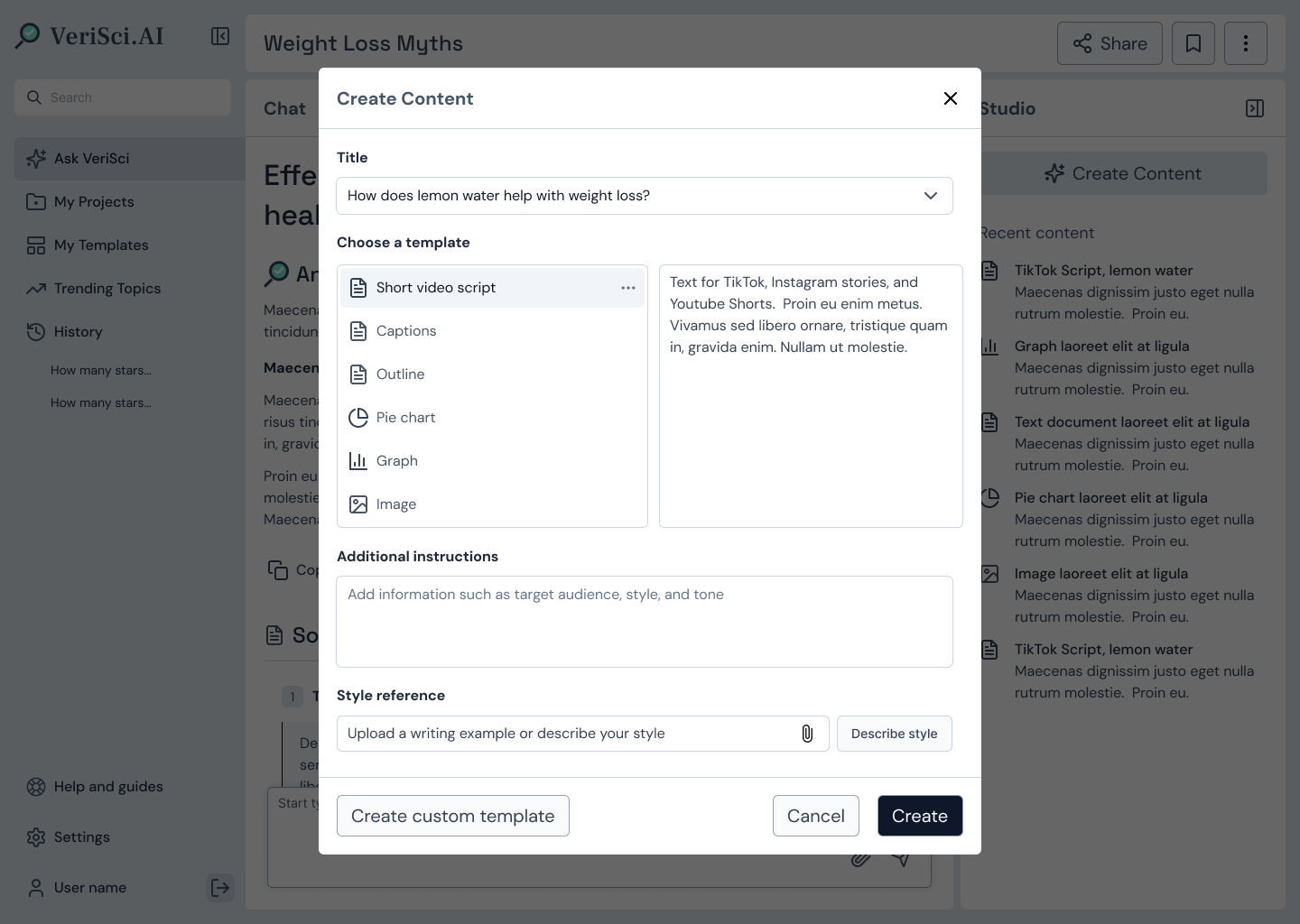
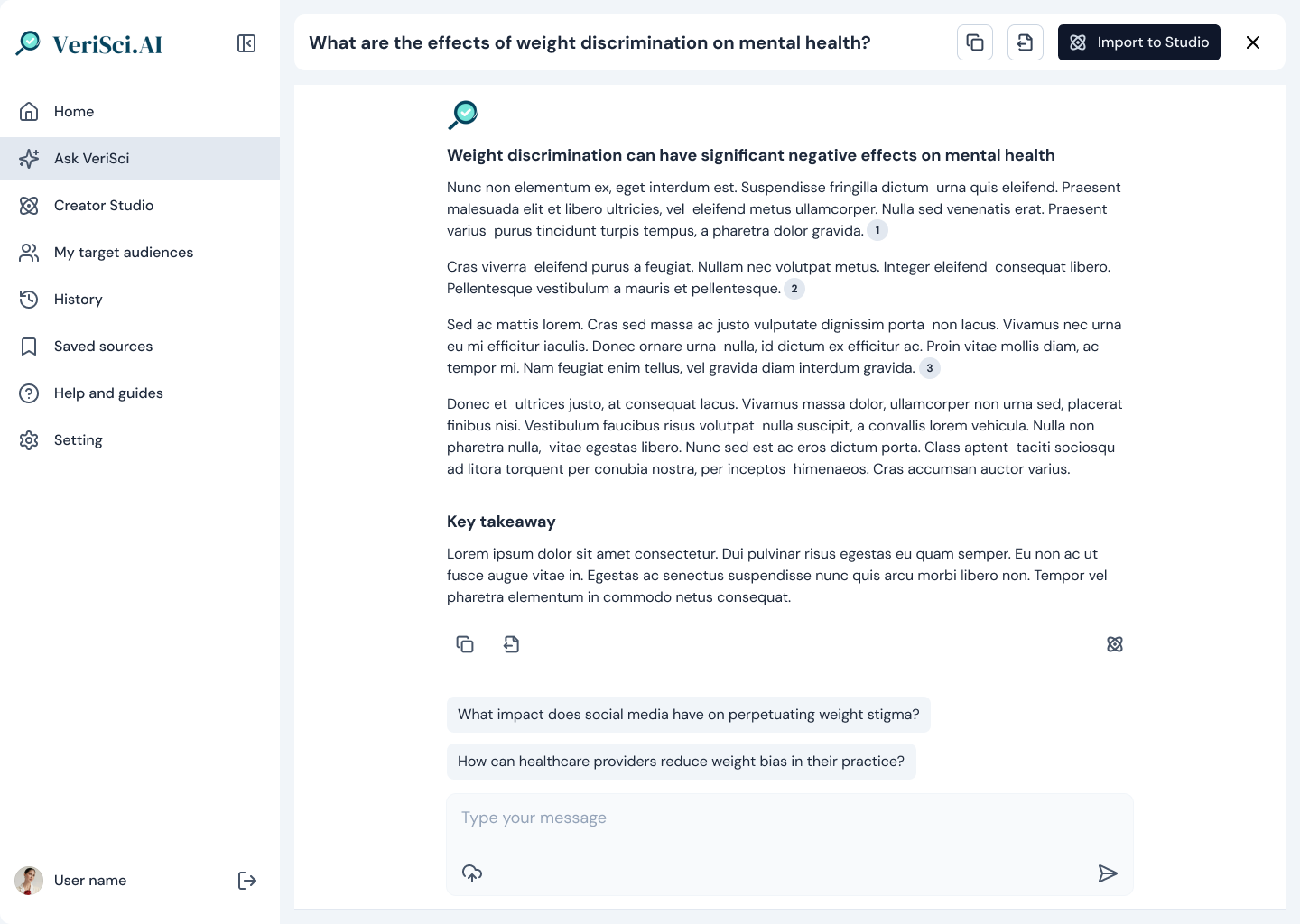
Core Product: The Desktop Platform is an AI-powered content creation studio that empowers creators with:
-
AI model fine-tuned in science communication best practices
-
Assisted content generation in the creator's unique brand voice
-
API integration to peer-reviewed scholarly sources for fact-checking and evidence-backed research




The Browser Extension
Companion Product: The Browser Extension is a lightweight research companion that integrates seamlessly into creators’ existing workflows - offering real-time research assistance and simplified translations of complex health concepts without disrupting creative flow.
Cross-Platform Flow
The browser extension delivers immediate value during the research phase, while the desktop platform unlocks deeper insights, analysis, and creation tools. Together, they form a complementary, connected ecosystem -the extension drives engagement and transitions users naturally into the full platform experience.


